
Feb 2017
Thinking, Fast And Slow? Some Field Experiments To Reduce Crime And Dropout In Chicago

Longer-Term Impacts of a Youth Behavioral Science Intervention: Experimental Evidence from Chicago
This paper details updated results from a study of Choose to Change® (C2C®), a trauma-informed cognitive behavioral therapy and intensive mentoring program developed by nonprofits Brightpoint and Youth Advocate Programs, Inc. (YAP).

Choose to Change® (C2C®) Program Guide
This program guide is intended for community-based organizations working to fill gaps in services and reach an underserved population of youth impacted by violence and trauma.
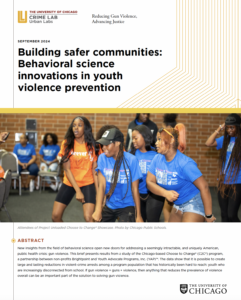
Building safer communities: Behavioral science innovations in youth violence prevention
This policy brief highlights results from a large-scale randomized controlled trial that evaluated the impact of Choose to Change® (C2C®) on participants’ criminal justice involvement.

Unpacking the Impacts of a Youth Behavioral Health Intervention: Experimental Evidence from Chicago
This working paper details results from a study of Choose to Change® (C2C®), a trauma-informed cognitive behavioral therapy and intensive mentoring program developed by nonprofits Brightpoint and Youth Advocate Programs, Inc. (YAP).
Latest Updates
Kelly Leonard: How improv can help police do their job
Kelly Leonard joins WGN’s John Williams to discuss The Second City’s partnership with the Crime Lab’s Policing Leadership Academy that’s using improv to help officers improve their communication skills.

Novel approaches can chip away at gun violence, and make a big difference
In an op-ed for the Chicago Sun-Times, Crime Lab Pritzker Director Jens Ludwig argues that when it comes to gun violence, we’ve been focused on the wrong solutions – a key insight from his new book, “Unforgiving Places: The Unexpected Origins of American Gun Violence.”

New book challenges conventional wisdom on Chicago shootings
Crime Lab Pritzker Director Jens Ludwig joins WGN’s Mike Lowe for an interview to discuss his new book “Unforgiving Places: The Unexpected Origins of American Gun Violence,” and how the book challenges our conventional wisdom about why shootings occur and how we can make progress on gun violence.