
Jan 2020
Rethinking the Benefits of Youth Employment Programs: The Heterogeneous Effects of Summer Jobs
This research paper presents the results of two randomized field experiments, which both involved offering supported summer job opportunities to different groups of young people in Chicago.

Longer-Term Impacts of a Youth Behavioral Science Intervention: Experimental Evidence from Chicago
This paper details updated results from a study of Choose to Change® (C2C®), a trauma-informed cognitive behavioral therapy and intensive mentoring program developed by nonprofits Brightpoint and Youth Advocate Programs, Inc. (YAP).

Choose to Change® (C2C®) Program Guide
This program guide is intended for community-based organizations working to fill gaps in services and reach an underserved population of youth impacted by violence and trauma.
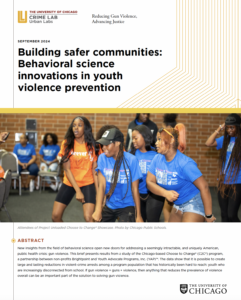
Building safer communities: Behavioral science innovations in youth violence prevention
This policy brief highlights results from a large-scale randomized controlled trial that evaluated the impact of Choose to Change® (C2C®) on participants’ criminal justice involvement.

Unpacking the Impacts of a Youth Behavioral Health Intervention: Experimental Evidence from Chicago
This working paper details results from a study of Choose to Change® (C2C®), a trauma-informed cognitive behavioral therapy and intensive mentoring program developed by nonprofits Brightpoint and Youth Advocate Programs, Inc. (YAP).
Latest Updates
Former NYPD Chief of Department Kenneth E. Corey Named Executive Director of the Policing Leadership Academy
CHICAGO, IL — The University of Chicago Crime Lab today announced that Kenneth E. Corey has been appointed Executive Director of its Policing Leadership Academy (PLA), a first-of-its-kind executive education program designed to help police leaders reduce gun violence and build trust in the communities they serve.

Homicide rate declines sharply in dozens of US cities, a new report shows
The AP’s Claudia Lauer speaks with Crime Lab faculty director Jens Ludwig about the declining homicide rate in cities across the United States.

What it will take to fix American policing
Host Megan McArdle speaks with former New York City police commissioner William Bratton and former NYPD chief and new Policing Leadership Academy executive director Kenneth E. Corey about their work at the Academy and the program’s goals to reduce violence and improve fairness in policing.